CONCRETE · AD 118 TO 128
One great shell
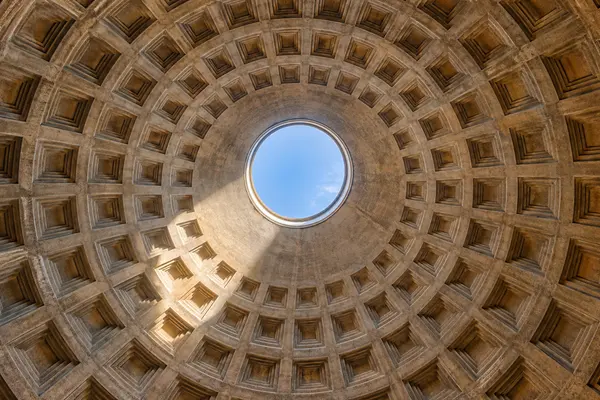
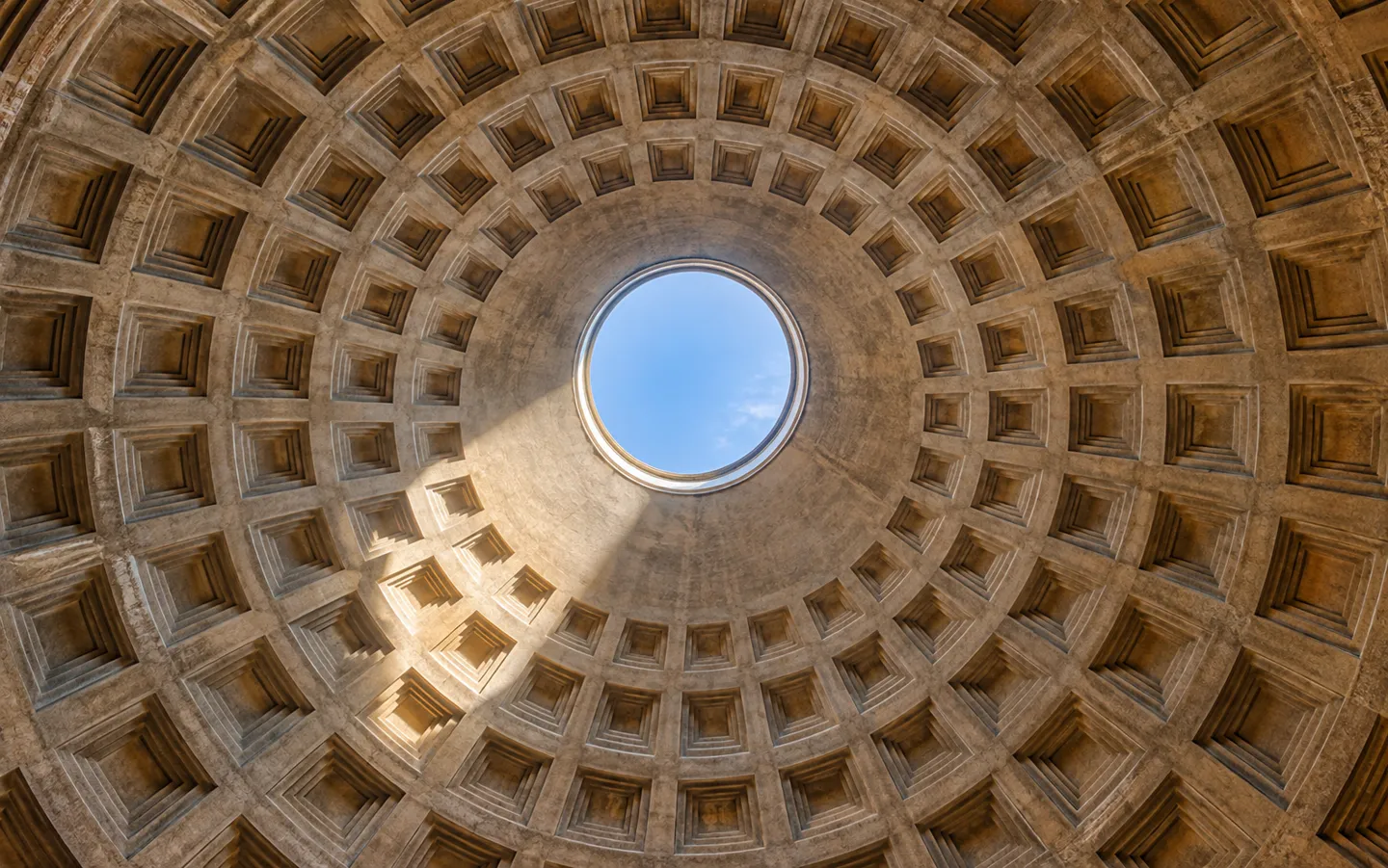
The Pantheon is concrete faced with brick, about 43 m across, with an open eye at the top instead of a heavy crown.
See the record doodledome
Start
A GUIDE TO GREAT DOMES
Concrete, brick, stone and steel triangles, holding up the sky indoors.
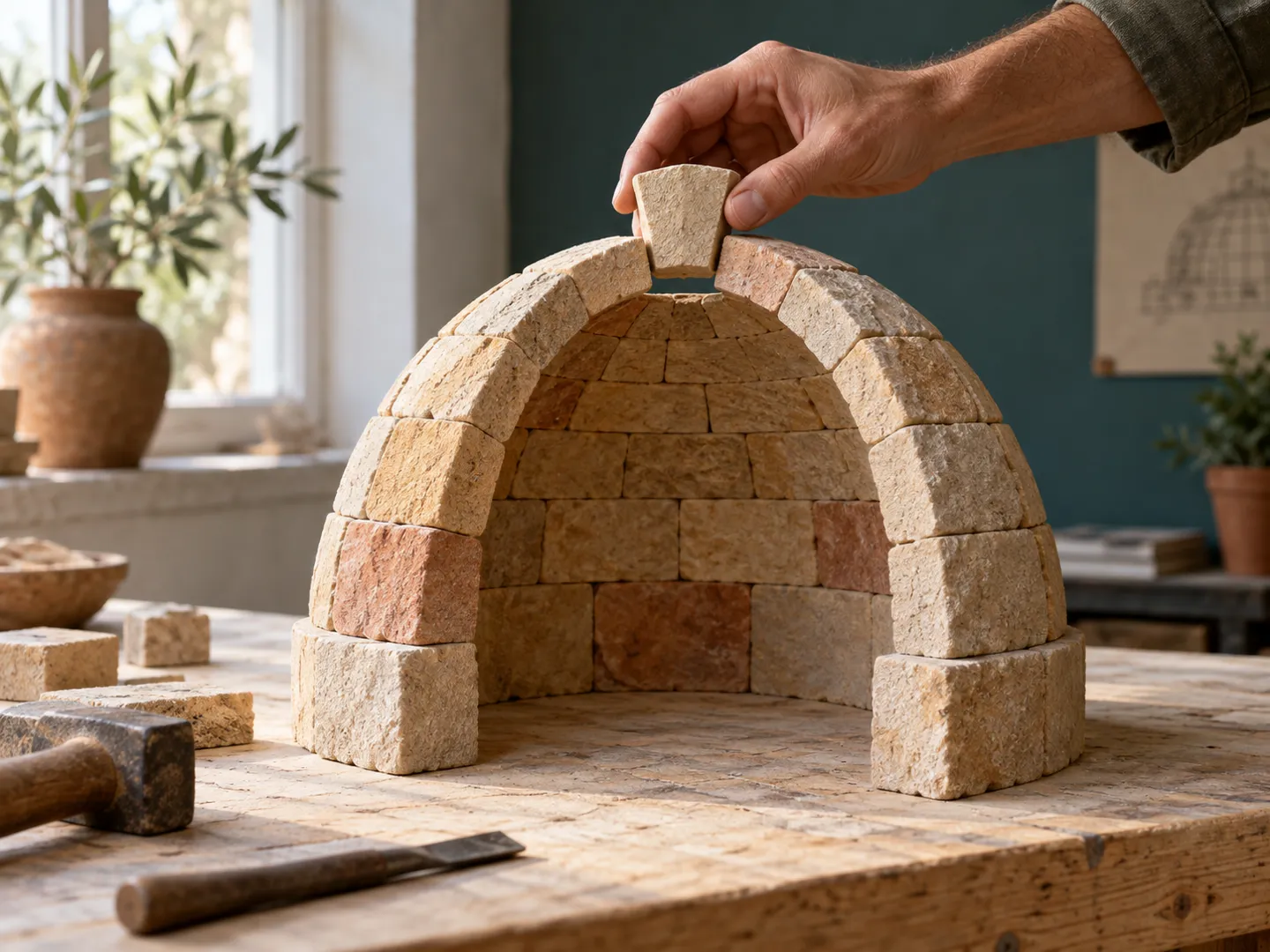
A dome is a curved shell with no columns in the middle. Builders have made them for nearly two thousand years, from Rome’s Pantheon to the steel geodesic spheres of the 1960s. Here is how five of the great ones were built, in plain English.
Plain English, with the sources linked.
LOOK UPno columns
Pick a domeKeep in mind
THE SHORT ANSWER
Three ways builders have spanned
a big room with no columns.
CONCRETE · AD 118 TO 128
The Pantheon is concrete faced with brick, about 43 m across, with an open eye at the top instead of a heavy crown.
See the recordBRICK AND STONE · 1420 TO 1710
Florence and St Paul’s used more than one curve: separate inner and outer domes, and at St Paul’s a hidden cone between them.
Inside the domeSTEEL · 1967
The geodesic dome breaks the curve into lightweight triangular facets, so a thin frame can enclose a huge space.
Compare the domesPICK A DOME
Choose a dome to see its headline number and the idea that keeps it up. The bar shows roughly when it was finished, on a line from AD 1 to 2000.
Figures come from the six sources at the foot of the page. Weights are the sources’ own estimates.
TWO RECORD BREAKERS
Thirteen centuries apart,
two very different answers to the same problem.
43 m about 142 ft
Diameter of the dome
Rebuilt under Hadrian between AD 118 and 128, the concrete dome rises 22 m above its base and was the largest dome built until modern times. The 8 m oculus at its centre is the building’s only light.
PANTHEON · ROME
37,000 tons
Estimated weight of the dome
More than four million bricks were laid between 1420 and 1436, without centring. The impost, where the curve begins, sits about 54 m above the ground, and the lantern on top was placed in 1471.
SANTA MARIA DEL FIORE · FLORENCE
Both domes are masonry, which is strong when squeezed. The Pantheon keeps its top light with an open eye; Florence spread its huge weight through two curved shells.
NEXT TIME YOU VISIT
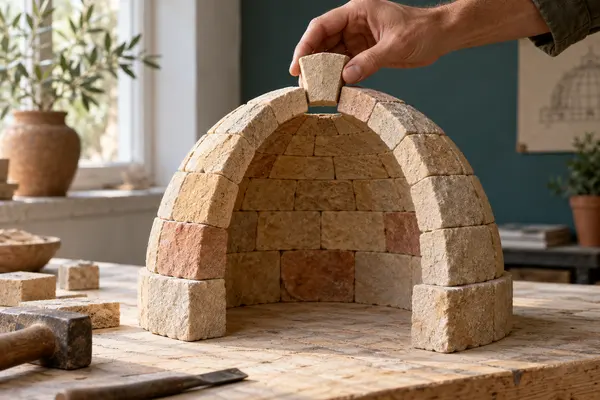
Step 1
Is the room round, square or eight-sided? On a square plan, look for curved triangles in the corners: those are pendentives.
Step 2
See where the daylight comes from: an open eye at the top, a ring of windows at the base, or a lantern perched on the crown.
Step 3
If the dome looks taller from the street than from the floor, there may be more than one shell, as at St Paul’s and Florence.
Step 4
On a geodesic dome, trace one line of struts. Every face is a triangle or a polygon built from them, even on a model made of sticks.
DOME FACTS

The Pantheon’s 8 m oculus, open to the sky at the centre of the dome, is the building’s only source of light. Rectangular coffers are cut into the ceiling around it.
Hagia Sophia, built from 532 to 537, uses curved triangular pendentives to carry a circular dome on a square base.
Florence’s dome was built without centring. Over four million bricks went into it, and its weight is estimated at 37,000 tons.
St Paul’s stands 111 m high and was the tallest building in London from 1710 until 1963. Its dome is really three: inner dome, cone and outer dome.
On 20 May 1976 a fire burned away the acrylic skin of the Montreal Biosphere. Its steel truss of triangles was left undamaged.
QUICK QUESTIONS
Short answers to the questions people ask most.
Britannica gives it as about 43 metres (142 feet) across, rising 22 metres above its base, with an 8 metre opening, the oculus, at the centre. It was the largest dome built until modern times.
Work began in summer 1420 and the dome was closed in 1436. It was built without centring, the wooden or iron structure normally used to support masonry while it is laid. Its weight is estimated at about 37,000 tons.
St Paul’s has a triple dome: an inner dome you see from inside, an outer dome you see on the skyline, and a central cone between them. The Royal Academy of Engineering calls it a masterpiece of structural engineering.
A geodesic dome is a near-spherical form made of lightweight triangular or polygonal facets, developed by the American engineer and architect R. Buckminster Fuller. The Montreal Biosphere, built for Expo 67, is 76 metres wide.
A pendentive is a curved triangle of masonry that makes the change from a square base to a round dome. Hagia Sophia in Istanbul, built between 532 and 537, is a famous example.
Destination
Updated
A NAME WITH ROOM ABOVE IT
doodledome.com is part of the DoodleSale portfolio. It isn't in an auction right now, but you can ask about leasing it.